

English
رؤى فكرية — مجلة علمية إلكترونية محكّمة متعددة التخصصات. Ruaa Fikriya, a multidisciplinary peer-reviewed scholarly journal. ISSN 3119-656X. Dépôt légal : 2025PE0064.

Journal research

Peer-reviewed research in law, economics and the humanities, with diverse scholarly perspectives.

124 articles

Issue 9Authors: 2Pages19–67

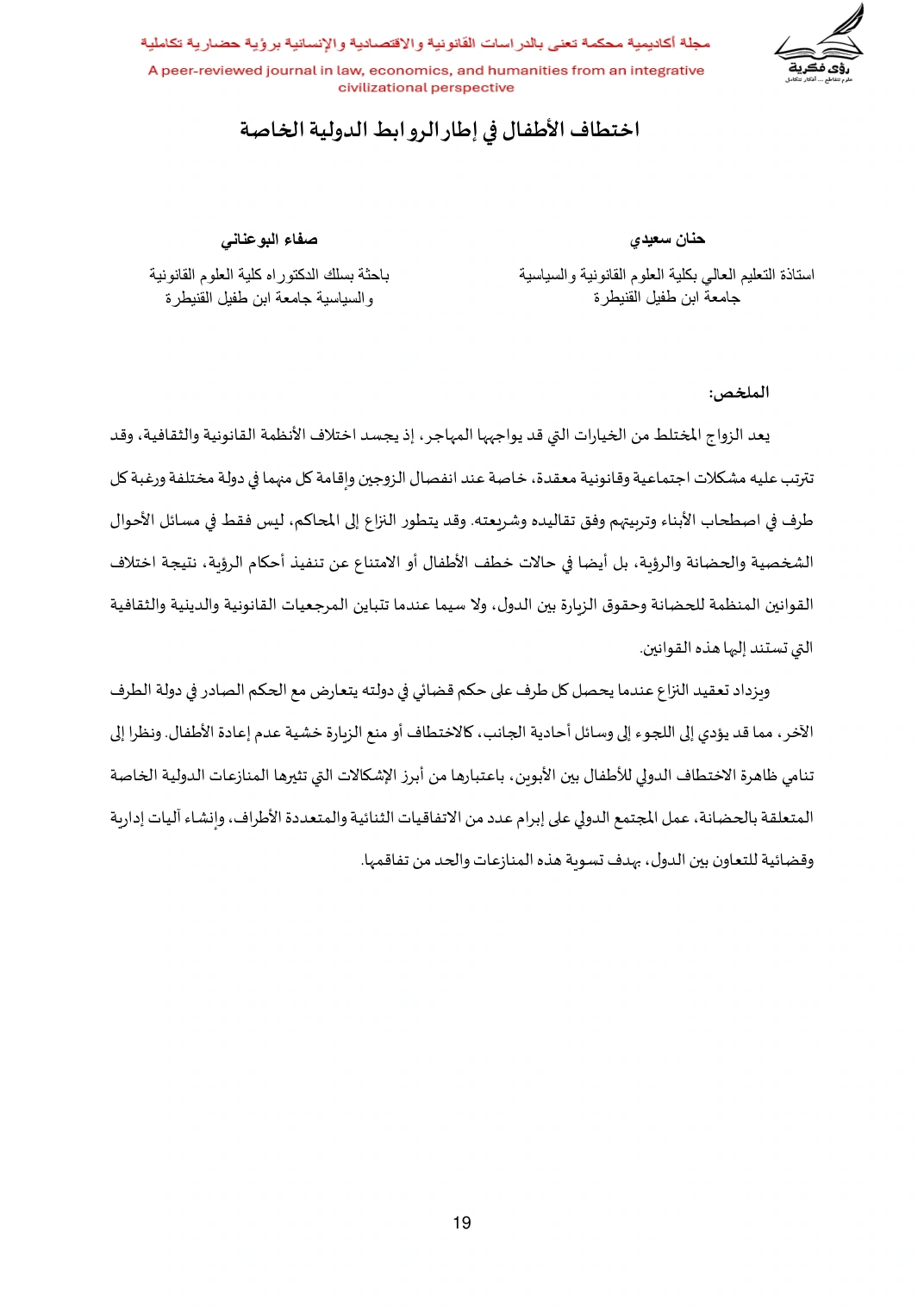
Child abduction in private international relationships

Mixed marriage is one of the choices that migrants may face, as it reflects differences between legal and cultural systems and may give rise to complex social and legal problems, particularly when the spouses separate and reside in different countries, with each seeking to take the children with them and raise them according to their own traditions and religious principles. Such disputes may reach the courts, involving not only matters of personal status, custody, and visitation, but also cases of child abduction or failure to comply with visitation orders, as a result of differences between national laws governing custody and parental access, especially where the legal, religious, and cultural frameworks underlying these laws differ. The situation becomes even more complex when each parent obtains a judicial decision in their country that conflicts with the decision issued in the other parent's country. This may lead either party to resort to unilateral measures, such as abducting the children or preventing visitation for fear that the children will not be returned. Given the growing phenomenon of international parental child abduction, which constitutes one of the most significant problems arising from international custody disputes, the international community has adopted a number of bilateral and multilateral conventions and established administrative and judicial mechanisms for cooperation between states, with the aim of resolving such disputes and limiting their escalation.

Prof. Dr. Hanane SAIDI
University professor, Faculty of Legal and Political Sciences, Ibn Tofail University, Kenitra.
Safaa EL BOUANANI
Doctoral researcher, Faculty of Legal and Political Sciences, Ibn Tofail University, Kenitra.
Issue 9Authors: 1Pages68–83

The legal liability of sports managers

This paper examines a highly significant topic, particularly in the field of sports clubs, namely sports management structures. There is no doubt that sound management of any institution or sector, regardless of its nature, is essential to achieving its intended objectives. This also applies to sports clubs, which have increasingly become major economic entities worldwide, as illustrated by the experience of European countries, with substantial capital and budgets that in some cases far exceed those of developing countries. Sports management is therefore an area that deserves further research and theoretical analysis. This paper seeks to examine the main legal responsibilities assumed by sports management bodies within sports clubs, with particular reference to the Moroccan legislative framework.

Dr. Ahmed CHERKI
PhD in private law; Faculty of Legal, Economic and Social Sciences, Mohammed First University, Oujda.
Issue 9Authors: 1Pages84–102

Legal protection of foreign minor players in professional football contracts: an analysis of FIFA rules and private international law

This study examines the legal protection afforded to foreign minor football players through the interaction between international sports regulations issued by FIFA and the rules of Private International Law. It aims to evaluate the effectiveness of the preventive system established by FIFA under Article 19 of the Regulations on the Status and Transfer of Players (RSTP), which sets a general principle of prohibiting international transfers of minors monitored via the Transfer Matching System (TMS) and the Sub- committee of the Football Tribunal while strictly limiting exceptions. Concurrently, the study highlights the complementary role of Private International Law when transnational sports rules conflict with national legislation, particularly regarding the legal characterization of professional contracts, applicable law determination, mandatory rules, and the international public policy exception. It emphasizes upholding the best interests of the child as enshrined in the 1989 UN Convention on the Rights of the Child. The study concludes that effective protection for minor athletes requires an organic integration between autonomous sports law (Lex Sportiva) and the sovereign oversight of Private International Law to balance commercial sports interests with fundamental human rights.

Younes EL KADDI
Doctoral researcher at the Faculty of Legal, Economic and Social Sciences, Fez.
Issue 9Authors: 1Pages103–129

Challenging the validity of electronic private documents in Moroccan and comparative law

This article examines challenges to the validity of electronic private documents under Moroccan law, in comparison with French and Egyptian legislation. It explores the extent to which traditional rules of evidence are compatible with the specific characteristics and intangible nature of such documents. It also examines the requirements for their legal recognition, particularly electronic writing and electronic signatures, as well as mechanisms for ensuring the identification of the signatory and the integrity of the document’s content. The article further highlights the different levels of electronic signatures and their impact on the evidentiary value of electronic documents and the allocation of the burden of proof in the event of a dispute. The article also discusses the applicability of the procedures for challenging the authenticity of documents through incidental forgery and handwriting verification to electronic documents, as well as the difficulties they raise. It highlights the importance of technical expertise in verifying the authenticity of electronic signatures and detecting forgery or alterations to electronic data. The article concludes that legislative intervention is needed to establish specific rules for challenging the integrity of electronic documents, taking into account their technical nature, in order to strike a balance between enhancing trust in electronic transactions and safeguarding the parties’ right to challenge their evidentiary validity.

Mohamed EL HARARI
Trainee lawyer at the Settat Bar and doctoral researcher, Mohammed V University, Souissi.
Issue 9Authors: 1Pages131–158

The Spanish High Commission in Northern Morocco under Lopez Ferrer (1931-1933): international tensions and internal security challenges

This article examines the Spanish High Commission in Northern Morocco during the mandate of Luciano López Ferrer (1931–1933), a period marked by political, security, and diplomatic challenges within the context of the Second Spanish Republic. It analyzes the difficulties faced by the Spanish colonial administration, particularly relations with France, the rise of the Moroccan nationalist movement, and internal security and economic problems in the Protectorate. The study explores López Ferrer’s administrative policies and his approach toward reforms, nationalist activism, and conflicts within the colonial administration. Based on a historical and analytical approach using Spanish and Moroccan sources, it highlights the limits of Spanish colonial governance and the tensions between maintaining colonial control and adapting to changing political and social realities.

Dr. Ghita EL AZRAK
PhD in contemporary history; Faculty of Letters and Human Sciences, Sais, Sidi Mohamed Ben Abdellah University, Fez.
Issue 9Authors: 3Pages159–177

Cannabis between addiction and dependence: a theoretical conceptual approach

This theoretical study addresses the recurring conceptual confusion between "addiction" and "dependence" in the context of cannabis use, through a critical review of the specialized psychological and medical literature. It distinguishes theoretically between a physiological dimension centered on tolerance and withdrawal (dependence) and a compulsive behavioral dimension centered on loss of control, craving, and continued use despite adverse consequences (addiction), drawing on Edwards and Gross's (1976) formulation of the dependence syndrome and on the neurobiological model of addiction developed by Koob and Volkow (2016). The study shows that cannabis represents a distinctive case in which both dimensions overlap: its classic physical withdrawal symptoms remain comparatively limited relative to other substances, while its compulsive behavioral dimension is more clearly pronounced—prompting the DSM-5 to replace the traditional dichotomous classification with the unified, severity-graded concept of "Cannabis Use Disorder." The study concludes with clinical and methodological recommendations, most notably standardizing terminology in Arabic-language literature, training practitioners to distinguish precisely between the two dimensions, and conducting empirical Arabic field studies to test this conceptual distinction.

Achraf FATH ALLAH
Psychologist and psychotherapist; doctoral researcher in psychology, Sidi Mohamed Ben Abdellah University, Fez.
Dr. Manar BEN EL BOUAZZAOUI
Clinical neuropsychologist; PhD in psychology, Sidi Mohamed Ben Abdellah University, Fez.
+1 contributors
Issue 9Authors: 1Pages178–205

Animal endowments in the Maliki school: a foundational study

This article examines the jurisprudential and civilizational dimensions of animal endowment (waqf) in the Maliki school, highlighting its contribution to animal welfare. It explores the concept and legal basis of waqf, as well as Islamic principles of kindness toward animals in slaughtering, milking, and riding. The study discusses the juristic debate over endowing animals for feeding and treatment and adopts the Maliki view permitting such endowments. It also examines the permissibility of endowing animals with recognized benefits, such as horses, breeding animals, and trained hunting and guard dogs, while presenting historical examples of endowments established for treating and feeding animals. The study further addresses the use of an endowed animal and its products, as well as cases of its death. It concludes that animal waqf reflects the Islamic values of mercy and benevolence and represents a valuable historical model that can be revived to support animal welfare, rural development, and environmental protection today.

Prof. Mohamed AJOUYID
Lecturer at the Higher Normal School in Martil, Abdelmalek Essaadi University.
Issue 9Authors: 1Pages206–222

The Commandership of the Faithful and religious observance: the historical role of Moroccan jurists in reforming religious practice

Religious observance comprises the devotional behaviours and practices that accompany Muslims throughout their lives and their journey towards God. It puts religious rules and principles into practice and is therefore distinct from religion itself, which the study describes as preserved and perfect. Throughout history, lived religious practice has required the intervention of jurists to reform and correct it. This explains the relevance of the research: religious observance sometimes approaches its intended ideals in everyday values, behaviour and ethics, but a substantial gap also emerges between observance and people’s conduct across different areas of life. This calls for reform and evaluation by jurists in their engagement with the public. The study situates this role within the Commandership of the Faithful: jurists act as representatives of the Commander of the Faithful in applying religious rules, guiding public observance and addressing shortcomings in the actual practice of religion.

Dr. Khalil MAHHAH
PhD from Ibn Tofail University, Kenitra.
Issue 9Authors: 1Pages223–249

Digital applications of zakat: an analytical and economic study of the Moroccan model

This study examines the digital applications of Zakat as a fundamental transformation in Islamic financial institutions, focusing on how digitalization can be leveraged to develop the Zakat institution in Morocco while preserving Sharia principles and governance standards. The study adopts a descriptive- analytical approach, supported by a comparative perspective between Morocco and leading experiences, particularly those of Malaysia, Indonesia, and Saudi Arabia, based on peer-reviewed academic literature. The findings indicate that digitalization contributes to improving the efficiency of Zakat collection through digital channels, reducing administrative costs, and accelerating the distribution process. However, several technical, legal, jurisprudential, and social challenges remain, including weak legislative frameworks, the digital divide, and emerging jurisprudential issues, such as Zakat on cryptocurrencies. In light of these findings, the study proposes a five-pillar roadmap for establishing a unified national digital Zakat platform integrated with participatory banks. Such a platform would enhance the efficiency of Zakat management, collection, and distribution while ensuring compliance with Sharia principles and governance requirements.

Abdessalam EL HOUDAR
Faculty of Sharia, Sidi Mohamed Ben Abdellah University, Fez.
Issue 9Authors: 1Pages250–262

The concept of psychic life between metaphysics and psychoanalysis: Bergson and Freud

This article aims to define the concept of psychic life between metaphysics and psychoanalysis, by comparing two opposing conceptions, namely the philosopher Henry Bergson and the psychoanalyst Sigmund Freud. The difference between their two theories is shown by Bergson's connection of the psychic life to pure Duration and the Consciousness that its processes interfere with pure memory, thus giving the psychic life a metaphysical concept. In contrast, Freud established a psychological and biological approach, which made the psychic life connected to the physiological unconscious processes. As for the dynamic process of psychic life, Bergson considered it a vital impulse, while Freud linked it to the instinctive libido energy.

Mohamed KABICH
Doctoral researcher in philosophy; Faculty of Letters and Human Sciences, Mohammed V University, Rabat.
Issue 9Authors: 1Pages263–286

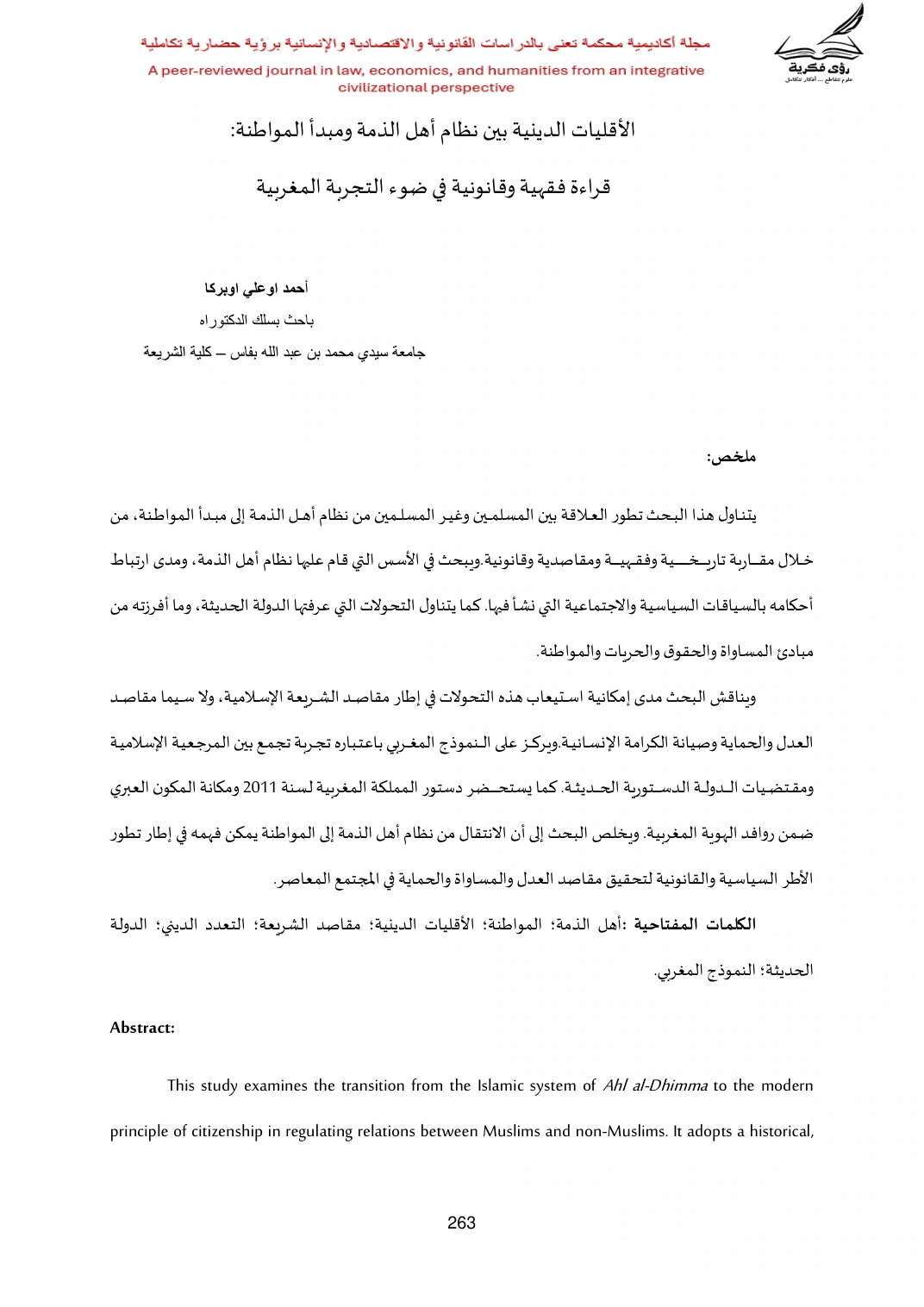
Religious minorities between the dhimma system and citizenship: a jurisprudential and legal reading of the Moroccan experience

This study examines the transition from the Islamic system of Ahl al-Dhimma to the modern principle of citizenship in regulating relations between Muslims and non-Muslims. It adopts a historical, jurisprudential, maqāṣid-based, and legal approach to examine the foundations of the dhimma system and its relationship to its historical context. The study also explores the principles of equality, rights, and freedoms established by the modern state and their compatibility with the objectives of Islamic law. Particular attention is given to the Moroccan model, which combines Islamic reference with constitutional principles, especially those affirmed by the 2011 Constitution. The study highlights the place of the Hebrew component within Moroccan identity and concludes that citizenship may provide a contemporary framework for realizing justice, equality, and protection while respecting the Islamic reference and the Moroccan context.

Ahmed OUALI OUBERKA
Doctoral researcher, Faculty of Sharia, Sidi Mohamed Ben Abdellah University, Fez.
Issue 9Authors: 1Pages287–305

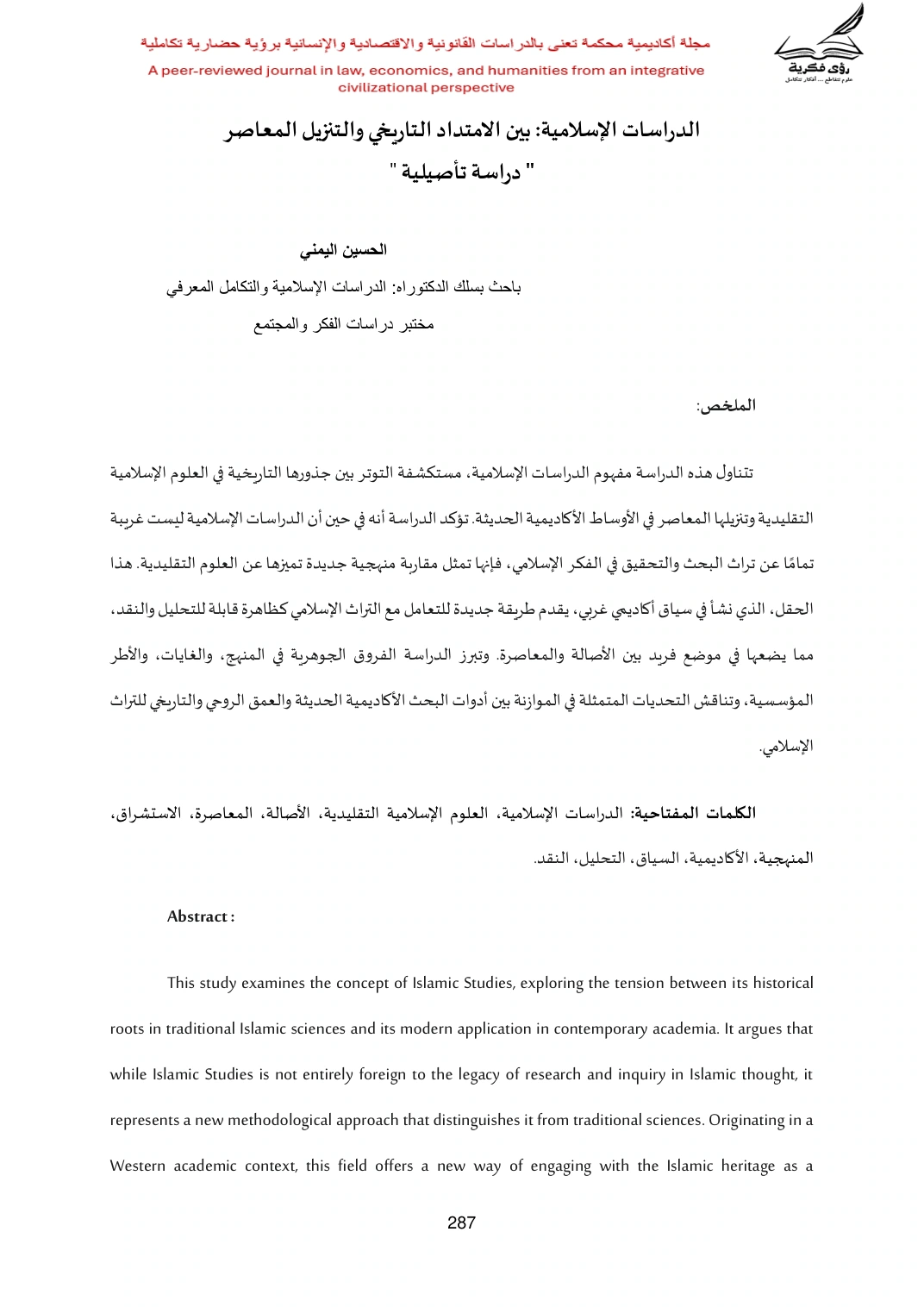
Islamic Studies between historical continuity and contemporary application: a foundational study

This study examines the concept of Islamic Studies, exploring the tension between its historical roots in traditional Islamic sciences and its modern application in contemporary academia. It argues that while Islamic Studies is not entirely foreign to the legacy of research and inquiry in Islamic thought, it represents a new methodological approach that distinguishes it from traditional sciences. Originating in a Western academic context, this field offers a new way of engaging with the Islamic heritage as a phenomenon open to analysis and critique, positioning it uniquely between authenticity and modernity. The study highlights the key differences in methodology, goals, and institutional frameworks, and discusses the challenges of balancing modern academic tools with the spiritual and historical depth of the Islamic tradition.

El Houssine EL YAMANI
Doctoral researcher in Islamic studies and knowledge integration; Laboratory for Studies of Thought and Society, Chouaib Doukkali University, El Jadida.
Confirm action